Category Archives: Fiction

Kedge Saves an Ace

2025 Submission to NYC Midnight’s Short Story Challenge

By Jim Janus

     In the backroom of the Frolics the game of twenty-one was dealt by a kid who didn’t look it himself. He’d been a sailor for a year and loved it. Except for the water. He feared drowning so much that he couldn’t pass the swim test. That earned him the name Kedge and a discharge he didn’t want.

     Though the Navy couldn’t teach him to swim, his shipmates taught him blackjack. One night he won big and celebrated by getting a tattoo. It wasn’t Ace-Jack. Instead it was eight, nine, three, ace. The design almost didn’t fit. It’s how the cards came.

     The failed sailor disembarked at Navy Pier and stumbled along Kinzie until Wabash, where portraits of showgirls drew him into the Frolics. The owner felt bad for him and made him blackjack dealer. DeCarlo and his wife didn’t have kids, so they cared for Kedge like he was their college dropout. Eventually Kedge dealt so many games he got comfortable with the clientele. He made them laugh and everyone liked him. Then, Edward “Eddie” Esposito took over the club.

     The final night of the Frolics was in ’58. The agreement between old and new was fair and square. After the last performance Eddie would get rid of staff and change the theme of the club. No burlesque dancing. No backroom blackjack. He was bringing in Jazz and he would name the place…Eddie’s.

     That evening before the doors opened, bright bulbs blinked a border around the marquee’s movable letters: FROLICS FINAL NIGHT! In the lobby DeCarlo came down from a stepstool. In his hands was a 1940s framed portrait of a platinum blond who was the mainstay of the club. DeCarlo looked at it and reminisced. Decades of running the place wore him down. He didn’t mind the takeover, didn’t mind the dull new name. What troubled him was finding work for Kedge and keeping the portrait without Eddie catching him. Eddie already claimed it for its collector’s value.

     Kedge arrived through the framed glass door and DeCarlo pulled him aside. “After tonight I’ll get you a new gig.” He handed Kedge the address of his new home outside the city.

     In the back room Kedge got the blackjack table set up. The club’s doors weren’t open yet but someone stepped in to gamble. It was Eddie. Kedge barely knew him but despised him for putting everyone out of work. Kedge was a straight dealer, meaning he always dealt the first card from the deck. But he mastered being able to deal the second card while keeping the first for later. He could help a player win or make him bust. Now he’d make Eddie bust to make him feel bad. What’s to lose, Kedge thought. I won’t see him after tonight.

     Eddie Esposito was known in Chicago not only for his nightclubs but for his trumpet playing. His head was nearly bald and he always wore gray slacks with a gray sport coat. He weighed over three hundred pounds. Maybe he got big from the steaks he ate, maybe he just had a big frame. Either way his massive stomach and chest gave him bulk to bounce unruly patrons and wind to blow his horn. And he did blow his horn. Not only during smoky performances but a blast or two as he was about to enter a club or a restaurant or a business deal. He always carried it. Because of this, some called him “the Elephant.” They said it behind his back. He was sensitive about his weight.

     The final night, the Frolics headlined Eddie himself. The master of ceremonies skipped out that night and DeCarlo needed a fill-in. That’s when Kedge got his big chance. The audience roared at his intro. Everyone loved it, except Eddie and DeCarlo.

     “He works for peanuts?” DeCarlo was dumbfounded when Kedge met him offstage. “I ask you to introduce Eddie the…” he caught himself, “and you finish with that old joke?”

     “Aw, come on DeCarlo.” Kedge smirked. “He’s got thick skin.”

     After Eddie’s performance all seemed good. His trumpet playing was as mellow as ever, the audience got what they came for, and DeCarlo smiled at the notes in the till. He then got in his Cadillac and headed home.

     Twenty-five miles northwest of the city, ranch houses of fresh brick were being bought by newlyweds planning families. Nightclub operators also bought houses there. In one a man was sitting across from his wife at the breakfast table. The two were noticeably older than newlyweds. The woman sipped orange juice while wearing dark sunglasses, a leopard print robe, and a silk scarf over her blond hair. The man held the Tribune and was reading an article.

     “Tipsie,” the man said. But he wasn’t stating a level of inebriation. He called his wife by her stage name. She was the burlesque dancer from The Frolics, the one in the portrait. DeCarlo, continued to speak. “They pulled a guy out of the Chicago River yesterday.”

     “That’s awful!” She gasped. “Is he dead?”

     DeCarlo read aloud. “Early Sunday the fire department rescued a young man found treading water just east of the Wabash Avenue bridge. He said he was working late Saturday and didn’t know how he ended up in the river. The man appeared to be hit on the head and didn’t remember his name. The rescue crew noted his bicep tattoo as a series of playing cards.”

     “Kedge!” Tipsie was stunned.

     “Thrown in by Eddie,” DeCarlo figured.

     “I hope he didn’t swallow river water.” Tipsie joked to calm herself. “That’d do him in.”

     She thought about the news and what DeCarlo told her of the closing. Tipsie knew how her husband did things and there were times she wanted him to be stronger. This was one of those times and she told him.

     “You shoulda stood up to Eddie after Kedge made that joke about him. Maybe then Kedge wouldn’t have ended up in the river. You gotta stand up for me too. Like with my portrait. You shoulda told Eddie to his face he can’t have it. Instead you stole it behind his back. You think he ain’t gunna come looking for it?”

     “He doesn’t know where we live.”

     “You think he ain’t never heard of the phone book?”

     DeCarlo drove downtown, found the hospital Kedge was in, and by dusk they were back at his house. Kedge wasn’t too badly hurt and his memory was fine. He wanted Eddie to think he was dead. It’s why he didn’t give his name when they found him.

     In the suburbs Decarlo got away from his persona of nightclub owner. He wore a khaki button-down shirt and shorts, and spent time in his basement with its dark paneling, leather couch, walnut bookshelf, and wet bar. On the wall hung an oversized panoramic print of the Serengeti at sunset. Next to it was mounted a replica long gun and a safari helmet. There was another framed composition but it wasn’t hanging. At floor-level leaning against the wall was Tipsie’s portrait.

     The basement den, DeCarlo thought, could be a good place to run a part-time blackjack operation. Now that Kedge was down there they would discuss it. DeCarlo turned a knob on the wooden hi-fi console and from within the orange glow of vacuum tubes escaped through its seams. He moved the turntable arm over a black vinyl disc, set the needle down, and let the player spin-out a tune of jazz piano. From a closet he brought out and set up a blackjack table. Kedge moved his hands across the flat green felt. He opened a deck of playing cards, cut it, and rifled them back together.

     The piano notes were calming until a different instrument joined in. Just for a moment, a harsher sound, a brassy burst. The two men realized the clashing notes came not through the cloth-covered speakers. They sounded from the top of the stairs.

     Heavy footsteps thudded down and there in DeCarlo’s basement, in gray sport coat and gray slacks, stood Esposito. In his right hand he held his brass trumpet with its bell showing a dent, the concave curve from Kedge’s convex head.
DeCarlo at that moment was behind the bar. He moved his foot in an attempt to slide the portrait out of view, but it was too late.

     “That portrait is mine,” said Eddie. He stepped to the wall and with his hornless hand lifted the frame. Then he turned and stomped toward the staircase.

     “Esposito,” a man’s voice said in a grave tone.

     Eddie turned and saw the low African sun eclipsed by DeCarlo–wearing the safari helmet and pointing the double barrel at him.

     DeCarlo continued, “The Frolics you can keep, but not the portrait.” Eddie surrendered the frame and DeCarlo demanded one more thing. “I want the trumpet too.”

     Tipsie was upstairs at the start of the commotion but now stood among the three men. Seeing DeCarlo pointing the gun both startled and impressed her. She knew it wasn’t loaded.

     Sweat showed on Eddie’s forehead. “Keep the portrait,” he said, “but I gotta have my horn.”

     These guys needed a way out of the situation, that was clear to Tipsie. It wasn’t her first time in the middle of a fight and she had experience calming men down.

     She called to Eddie, “Come sit at the bar, fella. I’ll make you a drink.” Eddie took his horn to a stool and Tipsie mixed a Manhattan. “Ya know what I think, Eddie? You’re scared of being vulnerable. I know ‘cause I make time with a lotta fellas. They tell me things they don’t tell no one else. Some, like you, think they can only get their way by bullying. You blast somebody with a note from your horn or hit ‘em over the head with it. And that’s just one of your problems. The other is that you’re afraid of lettin’ your feelin’s out. Your feelin’s are normal, Eddie. But you keep ‘em to yourself ‘til you play ‘em on stage. They make your music beautiful. But imagine if instead a blowin’ your feelin’s through your horn you whispered ‘em into some doll’s ear. I got it figured, Eddie. You’re scared without your trumpet. Scared you won’t get your way and scared your feelin’s will bottle till you burst.”

     Kedge chimed in. “Let’s make him win his horn back. One hand of blackjack–and you gotta hit twenty-one exactly. You do that and you get your trumpet.”

     Everyone liked the idea but Eddie. He couldn’t object because DeCarlo still had the gun on him. Kedge got himself behind the blackjack table, opened a fresh deck of cards and removed the jokers. He noticed Eddie’s forehead beading with more sweat. Kedge froze all of the sudden and the others could see that his mind was somewhere else.

     Kedge was back on a Navy ship, a night when his shipmates were giving him grief for fearing water. They were gunna make him swim by throwing him overboard. Then one of the sailors said, wait. Let’s make him play a hand of blackjack. If he don’t get twenty-one exactly, we toss him. Otherwise, from now on we leave him alone.

     Kedge remembered seeing the hand being dealt: eight, then nine, then three. He remembered himself sweating and starting to feel sick. Then came the ace. He wouldn’t drown.

     Now, back in DeCarlo’s basement, Kedge remembered the sailor who dealt to him. He remembered seeing something different about how the last card came out. The moment he won, the dealer looked at him. Kedge sensed he was about to wink.

     “Snap out of it!” Eddie blurted.

     Kedge dealt the first card, a two. Next a three. Then a four.

     “Hey, what’s the big idea,” Eddie protested. “Ya gotta mix them cards.”

     “Too late.” DeCarlo said, keeping the empty gun on him.

     Kedge continued. A five, then a six. He stopped. The total was twenty and it seemed certain the next card would be a seven. Eddie was pale and looked like he’d get sick. Then Kedge drew the last card, the one he’d been saving.

     Ace.

     Eddie thought he lost until Kedge declared, “That’s twenty-one!”

     Eddie was frozen for a few seconds. Then he rose from the chair and lifted his horn. He looked at Kedge and Kedge looked back, almost giving him a wink.

4 Comments

Filed under Fiction, NYC Midnight, Short Story

The Men in the City

The men in the city
Made a deal with the women in the city
The men would work every Tuesday and Thursday
The women would work every Monday and Wednesday
They’d alternate Fridays
The deal fell apart, though, by week three
That’s when they realized the old way was better

1 Comment

Filed under Fiction, Flash Fiction, Poetry

Retro Rocket

by Jim Janus

     Against the black infinity of space, a rocket-ship floated like a blimp above a long and gradual curve of the Red Planet. The ship’s bulging hull, like a mirror, gathered what could be seen–the field of stars, the distant sun, the rust colored horizon–and reflected it all back.

     Inside the rocket’s nose-cone, two figures in bulky spacesuits sat side by side, their white helmets facing the fore of the ship, their dark visors reflecting indicator lamps, and their thick-gloved fingers floating before an array of knobs and switches.

     The silver ship slowed, nosed up, then began its descent to Mars. The rocket descended vertically, a reverse of its liftoff from Earth. Fire-columns thundered from nozzles at the ship’s bottom. The blaze of orange and yellow pushed against the Martian ground, stirring red sand into a billowing cloud through which the ship set down on the planet.

     The engines quieted, and silence filled the ship. As the astronauts awaited their signal a speaker crackled with a voice, “This is Mission Control calling Vegas Station. Sandship One has landed.”

     Beyond the upright rocket’s porthole the night sky glimmered with pinpoints of bright white, but one shone a brilliant blue. The captain didn’t notice, but Lieutenant Ellison did. He used a scope to magnify the object, and discovered that the brilliance came not from a star but from a faraway planet with oceans of blue brightened by a more distant sun. Ellison gazed in awe of Earth.

     On Earth a small town slept as streetlamps shined orange onto tree-lined lanes. In the dark, dewy lawns lay in squares formed by sidewalks, and the walks leading to concrete stoops. Above each stoop, a single porch-light lit the front door of a brick home.

     Atop a shingled roof towered an aluminum antenna. It gathered radio waves and routed them down to a cool basement, dim and unfinished. There an aging man in a thick sweater sat at a wooden table before a shortwave radio. From the metal console a cable curled up to a pair of large headphones cupped over his ears. Through the headset a voice crackled, “Mission Control to Vegas Station. We’ve delivered your astronauts. Captain Borges, you and the lieutenant get some sleep. At dawn we’ll commence the Mars walk.”

     This transmission stirred the old man from his daydream, in which he saw the landing like those in the sci-fi movies of the nineteen thirties. Hearing the radio transmission assured him that now, men really would walk on Mars. He’d been waiting for it since he was a boy and wanted to be part of it. So he clicked a radio button and pulled forward a tall, chrome microphone and spoke, “This is Waukegan-One calling Sandship One.” Then he listened through the hiss and hum and squeal for a response, but the voice that came next came from behind him.

     “Dad?” His middle-aged son in jeans and a t-shirt called from the bottom of the stairs. “Dad!”

     The old man pulled off the headphones and swiveled around, his face feeling warm as he realized his son might have heard him. “You startled me. You’re back from the library already?”

     “I’ve been back for a while. What are you doing?” The son rubbed his own arms. “It’s cold down here.”

     The old man’s embarrassment went away. “Using this radio is my nighttime routine. Do you know it works as good now as when I built it fifty years ago?” The old man’s blue eyes became blank for a moment, then the spark returned. “How was the presentation?”

     “It was fantastic! The author discussed his book about the Mars mission. Tomorrow he’s touring the control room in Nevada. It’s from there that Borges and Ellison operate the mechanical astronauts.”

     Though the newspaper reported for months that the mission would be unmanned, the father rejected the idea. “Mechanical astronauts?” That’s no way to explore Mars! Man himself must take the ride, step off the ladder, feel his boot sink into the red dust. When life on Mars is discovered, Man must be there to look it in the eye!”

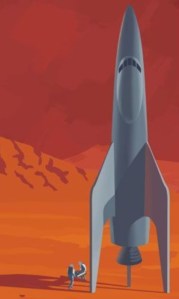
     The son smiled, familiar with his father’s retro temperament. “Like in that vintage sci-fi poster over your desk?” The son continued, trying to be kind. “Dad, you know rockets don’t land backwards. And ladders don’t slide down from under their fins.” Then he shook his head, “And as for looking a Martian in the eye…there’s no life there. The probes and rovers confirmed that.”

     The old man mocked, “The probes and rovers confirmed that.” Then he protested, “Technology has ruined it! The remote missions, the imaging, the Internet and its interactive globe of Mars. All this destroys our imagination, destroys the possibilities, destroys the wonder!”

     The son appreciated his father’s sentimentality. “Dad, come upstairs. We can watch the mission together. This one is different. The mechanical astronauts let us see through their eyes.”

     “Nah.” The old man dismissed the offer. “I won’t watch. But I’ll be up in a few minutes. First I need to write some notes about what the radio picked up tonight.”

     The son’s steps on the wooden stairs echoed off the basement walls, and the old man turned to the console. He put the headphones on, reached for the dial, pulled forward the chrome microphone and whispered, “Sandship One, this is Waukegan Station. Confirm Martian sunrise.” Then he continued a little louder, “Captain Borges. Lieutenant Ellison. Time to commence the Mars walk!”

     The old man’s mind resumed the movie. He imagined his message being converted into radio waves, sent up through the antenna into the still night sky, up into space where a planet shined red. On that world, rising above its rust colored horizon, the white sun silhouetted the standing rocket-ship. From it, a ladder slid down. Then an astronaut in a bulky spacesuit descended, and stepped back from the last rung onto the Martian powder. The figure turned from the ship and began to walk. It paused, knelt down, pulled off its glove, and plunged its hand into the soil. The astronaut brought up its cupped palm and let the red sand sift through its fingers.

     “Dad!” The son called down from the living room. “It’s started. Ellison’s astronaut has stepped out of the lander.”

     But the movie continued in the old man’s mind. The astronaut stood and removed his helmet, then his mouth shaped into a scream and his eyes grew wide, as he came face to face with a Martian.

Leave a comment

Filed under Fiction, Short Story

You Can’t Get There from Here (Installment #2)

???????????????????????????????????????????????????????????????????????????
I checked my watch and saw it was almost seven o’clock, so I asked the old man, “Is Nico Park still around here?”

“Around here?” the man asked back. Then he straightened up and said, “You can’t get there from here.”

This surprised me. I expected a yes or a no, especially from someone in the neighborhood. And, until I told the man my stories, I didn’t realize how much I wanted to get to the park. I thought maybe I confused him, so with respect I asked, “Did they get rid of the park? Build over it?”

He smiled again, and his gray-blue eyes showed me he was enjoying our interaction. “They didn’t get rid of it. You’re off by one. This is Cleveland Street. You want Keeney.” He pointed behind him. “Turn right onto New England. You’ll see the park at the next stop.”

“Thank you, sir.” I turned to my car, but then turned back to the man. I said, “Just one more question.”

The man nodded.

“At first you answered that I can’t get there from here. What did you mean?”

The man stepped toward me, and patted my arm just below the shoulder. “Young man, since you described the park by telling me of your evenings as a teenager, I know that it’s not just the park you want to get to. You want that feeling back.”

He said more than I expected. And while I thought about it, he pointed to the crossed street signs, thin and green atop the post.

“From this corner of course you can get to the park.” Then he pointed to my wrist–to my watch–and emphasized, “But from here, from right now, you can’t get to what you described.”

I did want the feeling back. He was right. And visiting the park wouldn’t do it.

“Still,” I told him, “seeing the park could help.”

“I understand,” he said, nodding. Then he asked, “Is it only the park that brought you back this evening?”

“No. I’m headed to Skaja’s Funeral Home.” And then I looked down, toward a crack in the sidewalk. “One of the guys from back then passed away.”

The old man’s eyes became serious, and he moved his head from side to side. “Too soon. Sorry to hear that.”

“We weren’t close,” I explained, “but I want to see him this last time. He worked around here for one of the big companies. Worked there twenty-five years. A friend of his from work said one day he just stopped showing up. HR called him and left messages, but he never called back. His friend drove to his place one lunchtime. Went to his apartment and found him.

The old man stopped me. “You said he worked for one of the big companies around here. Was it TechCorp?”

“Yes,” I answered, “TechCorp.”

The man removed his glasses, pulled out a handkerchief that was clean and white, wiped one lens and put the glasses back on. He seemed much more alert, and red colored his cheeks. “In the eighties I was TechCorp’s vice president of data processing. About the time you were playing ball at the park.”

This answer of the man’s also surprised me. I had not thought at all about his past.

“Are you retired now?” I asked him.

“I am. But I still try to keep up with how technology is evolving. I’ve a tablet that my kids bought me. I’m familiar with it enough to get to articles I need to read.”

“So do you live on one of these streets?”

“I used to. But the downturn that started in 2009 was pretty tough on me and my family.”

“So where are you at now? Do you need me to give you a lift?”

“When I get up to Waukegan Road I just need to head north a block. I live at the retirement home you used to work at.”

1 Comment

Filed under Fiction

You Can’t Get There from Here

Nico Park

This is the first half of a short story. I got the inspiration during an outdoor writing workshop with the Kenosha Writers’ Guild. We were given some prompts to use if we wanted. The prompt that interested me was, “You can’t get there from here.”  This is just the first half, so I apologize in advance for stopping in the middle. I’ll post the conclusion once I write it.

That evening the sun was far from setting, as on any June evening. Its glare came through the passenger-side windows of my car. It’s heat did too, even though the windows were up and the dashboard vents directed cool air.

The rush-hour traffic wasn’t bad, so I got into town earlier than I expected. The wake wouldn’t start until seven o’clock. So before I reached Oakton Street I slowed the car, waited for a break in traffic, then turned left off of Waukegan onto one of the side streets. The previous time I drove down that block–was thirty years ago.

The trees were a lot taller, but the homes which lined both sides of the street looked the same as they looked back then. Brick, one-story, with low, shingled roofs. Each with a front lawn, green and square, divided by a straight concrete walk. Each with three, wide, concrete steps up to the front-door. To one side a large front-room window. And to the other side a smaller, bedroom window.

I drove slowly along the quiet street. A few cars were parked on each side, and I weaved through to the end of the block. A little before the stop sign I pulled over, stopped, and turned off the car–to remember.

At the end of one of these streets there used to be a park. That’s why I turned. To see the park again. I was about to start the car to drive to the next block over, when I saw an old man walking on the sidewalk. He had just come around the corner ahead.

I lowered the passenger side window and called to him. “Excuse me sir. Is Nico Park nearby?”

He stopped, and stooped a little so he could see me.

I said, “I’ll come out.” And I got out of my car and walked up a lower driveway to the sidewalk.

I explained to him, “In the eighties I used to work near here at Waukegan and Caldwell. At the nursing home. In the kitchen. In the summer a group of us who worked there–we were all in high school or starting college–after our shift we’d drive to the park for its baseball diamond. We played sixteen-inch softball there. For fun.”

The old man cocked his head a little and looked into my eyes as if he did not understand.

I went on. “There were usually about eight of us. Enough for each team to have a pitcher, third baseman, shortstop, and outfielder. Kosta–he could hit the ball way out into left field, over the tall chain-link fence and into the tennis court. And Shimmo–he was a lefty. Whenever he came up to bat, the outfielder had to run all the way over to right-field, before the pitch. Shimmo could hit the ball beyond right-field and into the backyards. Sometime a neighbor would yell at us.”

The man listened.

“We liked when the girls played, but most of time Kathie and Debbie sat on the bleachers, and talked to each other and giggled.”

The man’s lips and eyes turned into a gentle smile.

“We’d play until it was too dark to see. Then we’d walk to our cars. The ones our parents let us drive to our part-time jobs. We’d lean on our cars and talk. No matter what we’d been doing–playing ball at the park, or having ice-cream at Dairy Queen, or dropping our quarters at the arcade of Par-King–those evenings in June we had nothing to do but to stay up and stay out. We’d lean on our cars and talk.

We talked about the girls we liked at work. Talked about the movies and music videos we’d seen. We talked about going to college, turning twenty-one, and how great it would be going to bars. We talked about what our real jobs might be.

The man’s smile started to go away.

It was almost seven o’clock, so I asked the old man, “Can you tell me how to get there? To get to Nico Park?”

2 Comments

Filed under Fiction, Short Story

Freedom Stream

Freedom Stream Color

By Jim Janus

In the year 2100 the Social Health Office sent a technician wearing gray scrubs to the one room apartment of twenty year-old Diego, and fitted him with a tiny receiver. By the end of the fifteen minute visit, as the technician gently sewed a single stitch into the back of Diego’s head, the Freedom Stream hit a milestone: Every resident of the city connected.

In his room with no desk or bookshelves, Diego smiled and called out, “Yes!” No more looking at the wall-screen or holding a blue-glowing device. Now, right into his mind streamed the popular songs, videos, movies, and shows.

Outside Diego’s apartment, traffic lights showed black. Since the second economic collapse fifty years prior, no traffic moved on the streets. Diego and most other citizens didn’t work. The city provided each resident with food, and a person rarely went out. The Freedom Stream deadened everyone’s curiosity about the real outside.

But the technology had glitches. And the next morning when Diego woke up he did not experience the relaxing wave sounds of the Stream. Instead he heard nothing. Silence, unfamiliar and unsettling, panicked him. So he immediately acted to restore the connection. Diego moved closer to the source which he knew to be atop the nearby, hundred-story, redbrick smokestack.

He left his unit and walked across the road, picked his way down the neighboring ravine’s brush and trees, and stepped over the abandoned rails to the lakefront. There Diego discovered a moored pontoon which buoyed a rust-colored steel container once used to transport goods. Its opened doors revealed attached shelves holding thousands of well-preserved books.

An unkempt, seventy year-old man appeared on the boat and looked at Diego, at his brown eyes of curiosity. The old man could tell that Diego’s connection to the Stream had been interrupted, that for only a few minutes the young man would be able to listen.

“Hello! My name is Amit. These books contain the unique thoughts of individual men and women. Each book is different. Each is a snapshot of the person’s thoughts at the time they wrote it. Unlike receiving the barrage of the Stream, reading a book is hearing a person’s thoughts in a way you control. Reading allows you to pause, to think about what you take in, to be aware of your reaction. The binding, paper, and ink let you feel the book, truly hold it.”

Diego stepped back from the stranger and thought of an excuse to get away. “Sir, I cannot read. They closed all the schools and libraries before I was born.”

Amit heard this from others. “I will teach you to read. And as important, I will teach you to write.”

“But today there’s nothing to write with. Nothing to write on.”

“I wrap twigs in foil and put them in fire to create pencils. I write onto scraps of paper. Seeing my thoughts in words amazes me. To have my own thoughts, to choose which ones I share, and to choose the words–that is human. The Stream takes that away.”

The Stream now crackled in Diego’s mind, the reconnection was starting. He felt unsure about the man and his offer. But he wanted to know more. Diego reached to the back of his head–for the stitch.

1 Comment

Filed under Fiction, Flash Fiction, Science Fiction, Short Story

Freedom Stream – A Very Short Story by Jim Janus

Selected as Winner of Waukegan Public Library’s 30th Annual Ray Bradbury Creative Contest (written-adult category)

Contest theme, from the WPL website

“Waukegan-native Ray Bradbury and author of Fahrenheit 451 understood the importance of reading, writing, and education to a successful society, saying “You don’t have to burn books to destroy a culture. Just get people to stop reading them.” Bradbury saw the slow destruction of books and the written word and was fearful. In Waukegan, not only do we see the rising popularity of eBooks, acronyms, and textspeak today, we live and work with those who do not even have the foundation of basic reading and writing skills in English or in Spanish. As the written word continues to disappear, the future of libraries, literacy, and free access to knowledge is uncertain. In your contest submission, please consider a future without the  written word. What would society look like? What would happen if your freedom to read and learn disappeared? How do you feel about banning books?”

Freedom Stream <— Click here to read the story

Leave a comment

Filed under Fiction, Flash Fiction, Short Story

The Village by the Sea

Sventoji

Saturday morning in the village, the visitors appear from wooden cottages and sit at tables on porches or in yards to nibble on cold meats and last night’s bread, sip hot tea, and choose from soft pastries the wives just bought at the nearby stands.

The voices are quieter and deeper as they retell what made them laugh not too many hours before, when each sat on moveable stumps–tree trunks recently cut and arranged around the fire–and ate and drank and sang.

After breakfast the visitors go inside, to put on bathing suits and fill their backpacks.  They come out again and walk in groups along the main street that leads them to the pines, and the narrow path that winds through them.

The scent of the green needles above and dry needles below confirms that the sea is very close.  Conversation becomes excited as the visitors reach the boardwalk which takes them to the top of the dunes and the open, far-reaching sky.  And then down to the sea, and to the wide, flat beach, bright in the sun, but cool and smooth on the sole, the rising waves coming at an angle, from the southwest, from Stockholm.

I don’t go anymore to the sea, like I did when I was a boy.  Now a man I spend mid-days in the village, sitting with my back to it.  But in late afternoon when many visitors are napping, the sound of the waves makes it here, and cool air touches my neck.

I sometimes sit across from the weathered garage where I used to work, and I peer over at the worn cars.  Visitors drove them here, three hundred kilometers from Vilnius and Kaunas, and they need repairs before the return trip can be possible.  Years ago, few of the villagers had the skill to replace a belt, or a radiator, or a wheel.  Now, men from other countries move here.  They work on the cars for less.

The owner kept me.  Each morning I would go there and sit.  I would watch the others arrive and begin on the cars.  They acted kind to me, let me deliver this or that.  They didn’t tell me to go.  I left without saying.  Stood from the bench and walked away.  Past their backs, their heads disappeared between open hoods and lifeless engines.

Each day I stop by the churchyard.  The nun there washes my clothes along with the rags she uses for cleaning.  I like to clip the grass around the wooden carvings of the saints.  Sometimes there a visitor will give me a coin.  Most days I accept enough to buy bread, or a piece of fresh meat, or a piece of smoked fish from a cart.

Yesterday while walking along the road in the direction of the bus station, a woman asked me if I had enough to eat, if I needed newer clothes.  She said I reminded her of her grandfather, my blue eyes and light hair.  She gave me these coins saying I might want to go to the city.

Tomorrow I will use them–to sleep one night here, in the smallest cottage by the sea.

1 Comment

Filed under Fiction, Flash Fiction, Short Story

The Robin

The Robin
He put the two spoons into the tray in the kitchen drawer, folded the dish towel over the oven’s handle, and turned to the living room.

“Thanks for dinner,” he called to her.  “Your vegetable soup is always excellent.”

She smiled and settled down into the loveseat, leaning her back against one armrest.  The sun brightened her as it moved lower behind branches and changing leaves.  She liked to watch the birdfeeder at the back.  Yesterday morning two faded cardinals perched on the corner post of the wood fence.  One peeping, as the other hopped to the feeder and back with the dark seed.

Now there were no birds.

She rested her hand on her stomach and looked at her ring.  Then she pulled up her knees and wrapped herself in a brown blanket, her lips straight as she looked again through the large window onto the yard.

He knew she wasn’t thinking about what was out there.  He called to her, “Will you go for a walk with me?”

She turned to him, relieved by the interruption.  “Of course I will, honey.”

He said, “I first need to check my work email.”

<><><>

In the laundry room each put on shoes and a jacket.  She asked, “Where do you want to walk?”

He chose a route he thought would get work off his mind, so he could think with her about what happened in the morning.  “Let’s leave the subdivision, and go to the farmer’s field.”

She took the flashlight from the shelf.  “We’ll need this for the way back.  It gets dark early now.”

They walked down the driveway into the cool, graying evening.  Before crossing the quiet side-street each felt for the other’s hand.  In a minute they turned onto the half-mile stretch of road that ran north, alongside a line of trees that screened the county bike trail.

He said, “I like this road.  The old trees on both sides, all the way to the end.  And I like that it’s straight, that it rises and dips a little, like a real country road.”

“And I like the rabbits,” she said.  She pointed to a gray-brown, furry lump.  It was still, and facing into the trees by the trail.  “He thinks if he doesn’t move we won’t notice him.”  Then she called sweetly, “We see you!”

She added, “I like the trees too, especially now with the colored leaves.  But the mailboxes.  Why are they on the trail side?  The people have to cross the street to get their mail.”

“I never thought about that.”  And he smiled knowing that what he’d say next wouldn’t satisfy her.  “Maybe the village wanted the boxes on the same side as the telephone poles.”

She liked when he made up answers for things.  But she let him know when he didn’t come up with a good one.  “They’re simply on the wrong side.”

Behind them the whisper of a car’s tires on pavement came closer.  They moved over to the narrow strip of gravel.  The car passed slowly and continued on.

“At least there aren’t many cars,” he said.

They became quiet in their own thoughts.  He looked toward an open garage with tools covering the inside walls.  She, at fall flowers in a garden near the road.

As they continued to walk, he said to himself, “Telephone poles and mailboxes.”  Then out loud, “It’s easy here to imagine it’s the seventies.”  He started to daydream and said, “Simpler times.”

They passed a house that, like the others, sat far enough back from the road that a group of old trees could spread their jagged limbs over the large front yard.  A long, gravel driveway bordered one side of the property and gave some weathered, undriven cars a place to be.  The small house’s front door was on a cement stoop.  Next to it stood a tall aluminum pole.  At the top the American flag drooped motionless, faded.

After the house he saw the mowed grass of the park-district baseball field.  No one was there.  In a far corner, a flat area of sand marked the infield.  The tall, chain-link backstop drew his gaze.  Behind it a line of trees screened a two-lane county route that ran the same direction as the road.  From there a high pitched trill of a squad car came and went.  It woke him up from his slide into home-plate.

“Those times seem simpler to me,” he corrected himself, “because I was a boy then.”

She looked at him and smiled.  “I’d like to have seen you as a boy.”

“A boy,” he repeated in a whisper.  Then he spoke in the serious voice he used when talking about his job.  “They’re cutting costs again.  I won’t get the new position.”  Then with a gentle voice, the one he used to ask her for help.  “Why do I stay at that place?  Twenty-five years under fluorescent lights.  My back to the window, the kind that doesn’t open.  Each day is the same–the building won’t let in the season.”

She wanted to say something, like if she owned a company he’d be CEO.  She knew he did well at his job, and hoped with him for a position where he could do more.  But she also liked that he came home at dinner.  She squeezed his hand and said, “I’m sorry, honey.”  And after a pause, “Maybe that new position would have been too much.”

On other walks they wouldn’t hold hands the whole time, but this time they did not let go.  His hand stayed warm because she was holding it.  And at that moment he thought only of her, that she cared for him, that she encouraged him to appreciate family, that she encouraged him to pursue his creativity.

She went on, “Today Agnes asked me to take her to the club.  Years ago she’d pass the time there since Joe was putting so much into his career.  They never had children.  She said they didn’t want kids.  Now there’s none to look in on them.  They need me to take them to the doctor, to help them around the house.  I cross their street to bring in their mail.”

He thought of their being old one day, sitting together at home.  No doorbell.  No ring of the telephone.  Emptiness.

<><><>

At a half-mile they reached the road’s end, the T at the east-west street.  They crossed to the field.  It was lined with stubs of dried cornstalks.

He looked up slightly, into the distance as far as he could.  Low in the west, pink wisps of clouds glowed in front of deep blue.

“The sky,”  he said, “It’s so big here.  So open.”

She too liked the view there, especially after sunset.  “It’s beautiful.”

He looked into the field.  “Last Saturday I saw them having a bonfire and hayride over there.  Boys and girls laughing and screaming.  Really having a good time.”

She smiled.  “Makes me think of when I was a girl.”

A group of robins fluttered among the top branches near the trail.  She looked at them and forgot the rest of what she was going to say.

He’d never seen her pay attention to robins.  She would look for birds that were harder to find.  “What is it?” he asked.

“I just had a memory,” she answered.  “When I was a girl, I would walk with my older sister to and from school.  One time it was spring and we were going along the path through some trees.  On the ground I found a tiny blue egg.  It was cracked and empty.”

He started to say it’s not unusual, but stopped.

“When I stood up, just a little higher than me I saw the nest.  And poking above it, I saw the head of the mother.  I remember her eye, round and black.  She was staring at me like she knew the egg was gone, like she knew there was nothing she could do.”

He put his arm around her.  She rested her head on his shoulder and he could feel her shaking.

She sobbed.  “I told the robin that everything would be okay.  I told her she would have others.”

He hugged her and listened to her cry.  And he began too, in his chest and throat and eyes.  He swallowed.  Then he said quietly, “We’ll try again.  Like the doctor said.”  They held each other for a minute as the sky became a deeper blue.

A single screech of a young great horned howl came from the trees.  Then, overhead, the silhouette of the mother’s outstretched wings glided silently into the woods.

He said, “Let’s go back.”  And before crossing the east-west street each felt for the other’s hand.  She felt hers become warm, because he was holding it.

Leave a comment

Filed under Fiction, Short Story

In the Small Garden of Fruit Trees

Butterfly

Here–there is some peace by the sea, and in the small garden of fruit trees.  Where in late August I sit and watch the butterflies work within the leaves and branches, around the attached apples.  It’s work for the butterflies.  But their fluttering and swirling looks like dancing.  One settles on an apple, then lifts, and flies directly to me.  It lands on my white shirt, its red-tipped, black wings opening and closing.  One day I watched for hours.  They don’t go to the sea, and they don’t go to the village.  In the evening they find someplace here to sleep.  I know this because the next morning I see them again, circling in the new sun, while the visitors still sleep or have just gotten up, to nibble on last night’s bread and cold meats, heat up water for tea, and prepare pastries for breakfast.

2 Comments

Filed under Fiction, Poetry