Category Archives: Non-fiction

End My Breakup with the Bears?

By Jim Janus

The Chicago Bears.

They won the Super Bowl in 1986. Then decades of heartache followed. For me it became an unhealthy relationship. Night-game losses to Green Bay hurt the most, ruined the night and the following day.

In 2007 the Bear’s Super Bowl loss to the Colts was all I could take. I broke up with the Bears and eventually stopped watching football altogether.

A number of times since 2007 the Bears reached the playoffs–never the Big Game. It didn’t concern me because I didn’t watch. I put time into other things.

Nineteen more years passed and January 2026 came. I learned the Bears would face the Packers for the next step toward Super Bowl. They’d play on a Saturday night.

I weakened.

I came up with an excuse for watching. The game would make history no matter who won. I’d watch without rooting for either team.

But my calendar was booked. Saturday evenings I join my parents for pizza at their place. They’re in their nineties and follow strict routines. Dinner’s always in the dining room, no TV during dinner.

I needed to skirt the TV ban. That night only–that’s how I’d sell it–we’d watch while having pizza. It should be a fun change.

I phoned and they were quick to agree. Dad’s a Bears fan. Mom is too. She mostly likes watching us watch–and providing color commentary sometimes insightful, sometimes ridiculous.

Now I could watch the game without ending my Bears breakup. If anyone challenged me I could say my parents put the game on.

But we needed a screen in the dining room. Their TV’s too big to move from the den.

Abetting my own crime I brought my laptop. I put it right there on the dining table and streamed the broadcast.

As we awaited the kickoff we talked about 1985 and the parties and fun those games gave, watching McMahon, Payton, Perry, and team.

Now we hoped these Bears would win. But as we progressed through cocktails, dinner, and dessert we watched Chicago trail.

Before halftime my dad wrote off the Bears, noting their defense wasn’t strong enough to enable a win. Around 10 PM we watched the Packers get 6 more points.

27 to 16 with only 6 minutes left? I tell Mom and Dad, “I’m taking my computer and going home.”

As I’m packing, my dad walks to his den and turns on the TV. He calls me, extends the remote and says, “find the game.” I press the mic and say “Chicago Bears.” Bright green turf lights up the screen. Players in navy and in yellow move about. The score now shows Packers 27, Bears 24.

What?

Somehow the Bears scored 8 points during the brief blackout I imposed.

So there we are, my dad and I standing shoulder to shoulder, and my mom’s now in the den too, in a chair that’s facing us rather than the TV, and she’s watching Dad and I standing and cheering for the Bears like we did so many decades ago.

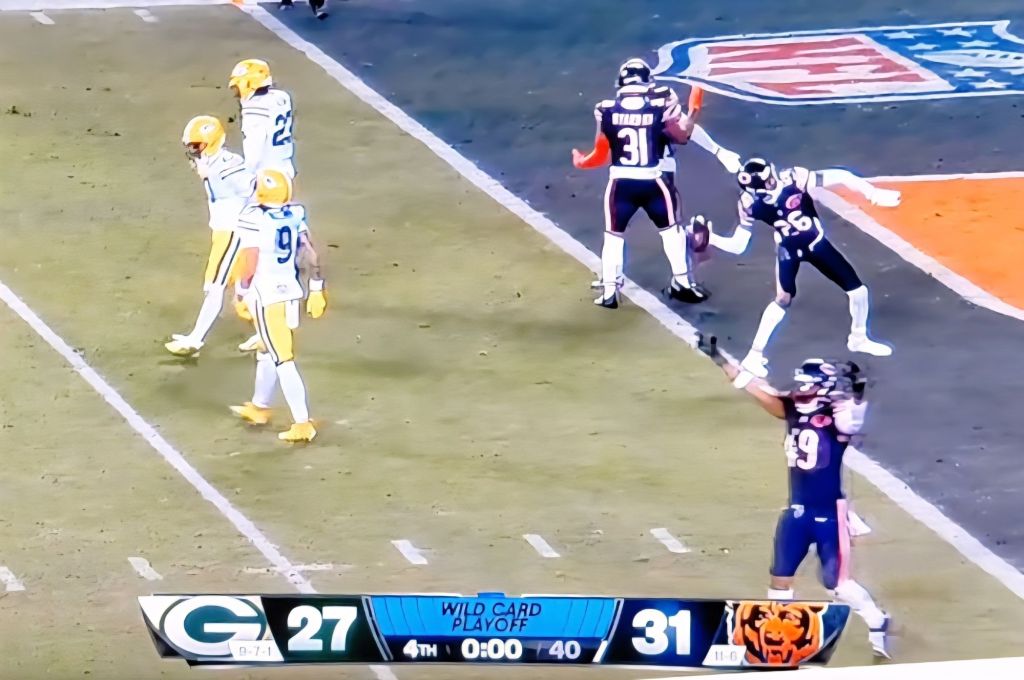
We watch the Packers miss a field goal with less than 3 minutes left, watch the bears get a TD with less than 2 minutes left. Now the Bears are ahead 31 to 27. They hold the Packers and ultimately break up their pass in the end zone to seal the win!

What a great time my dad, mom, and I had. Especially those last minutes of the game. It felt a bit like ’85.

Now I’m planning to watch the next game with them.

As for the Bears and me… Will I go back to being a fan? I’m telling myself to be strong. I’ve been hurt too many times. 😉


Leave a comment

Filed under Essay, Non-fiction, Nonfiction

You’re an Immortal

An essay by Jim Janus

I’m a god. I’m not the god. I’m a god. I’ve been stabbed, shot, poisoned, frozen, hung, electrocuted, burned. Every morning I wake up, not a scratch on me, not a dent in the fender. I’m an immortal.

So claims character Phil Conors in the movie Groundhog Day. The jaded, arrogant weatherman somehow gets stuck in a cycle where–for him only–each day is February Second in Punxsutawney, Pennsylvania.

Phil’s miserable because he’s in his fourth year on Pittsburgh TV and wants to be on a major network. He thinks he’s too good to cover the Groundhog festival and insults everyone along the way.

Phil’s misery increases when he can’t escape Punxsutawney. Each time he wakes on what should be February Third, he again hears the clock-radio sounding Sonny & Cher’s I Got You Babe and a pair of broadcasters calling, “Rise and shine campers, it’s Groundhog Day!”

After so many repeats Phil can’t take it anymore. He tries to kill himself, but after each unique attempt he wakes to the radio’s groundhog greeting.

The movie is fantastical, of course, because none of us lives the same day over and over.

Or do we?

My days are mostly the same. I get up at the same time, drive the same route to work, park in the same spot. I push through the same door, walk the same hallway, sit at the same screen.

Years ago the sameness made me almost as miserable as Phil. I was in my eighth year with a tech organization and thought I was sharper than my peers. I expected a promotion but kept getting the same assignments. My career in application development became a drudgery.

I never expected I’d lose interest. As a teen I taught myself BASIC on a home PC; in college I never skipped a computer science class; with my bachelor’s degree I chose a job as a mainframe programmer.

Those early years of learning, compared to my recent decade of doing revealed I’d become developmentally stagnant.

Stagnant like Phil. But he can remember from one repeat-day to the next and do things differently. The repetition that made him miserable becomes his means to fix the day. He masters new skills and puts himself in the place and time to use them. Not only does he rescue locals, he uses trial and error to make himself attractive to the woman he loves.

When I could no longer take my stuckness, I drove fifty miles to Chicago and attended a comedy writing workshop at The Second City. The Saturday introductory session was my first try at change (while keeping my day-job). I didn’t continue there, but with the city in reach I joined Chicago Dramatists for a playwriting course.

Early each Saturday I printed copies of the latest scene I’d been polishing, set the pages on the passenger seat, and drove to West Town. There in a small theater, professional actors read aloud what I and other students wrote. After each reading we discussed the parts we liked. We were becoming better writers.

After several semesters of playwriting I switched to Story Studio Chicago for workshops in fiction writing. There I learned techniques used in short stories. Since then I wrote a number of short pieces and had some success in writing contests.

Phil’s transformation from insulting people to bringing them joy is what lets him break through to February Third. For me, the fulfillment I get from my writing lets me see beyond the repetition of my job. Each day I look forward to the hour or so that I get to tinker with my current creative project.

Near the end of the movie, the woman who Phil’s in love with sees how happy he is. She’s heard from locals how he’s changed their lives. The two go for an evening walk and she says to him, “It’s a perfect day. You couldn’t have planned a day like this.” Phil replies, “Well, you can. It just takes an awful lot of work.”

Is your today a lot like yesterday?

Will your tomorrow be a lot like today?

Rise and shine, camper!

Like Phil, you can go beyond your job to become yourself. You can experiment and learn. It takes effort, and it might hurt sometimes, but every morning you’ll wake up, not a scratch on you, not a dent in the fender.

In that way, you’re an immortal.

Leave a comment

Filed under Essay, Non-fiction

Lichtenstein’s Starbursts

Illustration

Rewrite of a non-fiction piece I wrote for the 2012 fall edition of Left of the Lake magazine

Roy Lichtenstein is known for using primary and secondary colors to paint organized dots which turn familiar objects into pop art.

Lichtenstein. He’s only dots. Filled circles of uniform size and repetition. That’s what I thought before I visited Chicago’s Art Institute and viewed Haystack 1969. Lichtenstein’s impression of Monet’s impression of a haystack.

As I approached the painting I recognized Monet’s image. But Lichtenstein’s work is not a copy. It’s another masterpiece.

I looked up-close and the haystack vanished. Genius appeared. A yellow background behind red circles evenly spaced and sized. And repeating white shapes that are not dots, but six-pointed starbursts.

Something other than dots? In a Lichtenstein?

Further in the exhibit I discovered a sketch titled Haystack and Haystacks (Studies). It’s Lichtenstein’s 1968 plan for the 1969 painting. I saw the plan! A pencil drawing and margin notes regarding arrangement of dots and colors. It revealed that each starburst is background showing through the center of overlapping dots. Maybe you knew, but I needed the notes.

After my visit I went home to experiment with this technique. I used a laptop to arrange solid circles into a ring, leaving room in the center for a starburst to appear. I then copied the dot cluster and pasted it several times, creating a pattern of foreground starbursts against what became a background of overlapping solid circles. (See the image at the top of this blog entry.)

Placing dots in a circle is easy. But how to configure the dots to create a desired shape? And how to construct the pattern? There are many possibilities. As I thought through the arrangement problems, I wondered if Lichtenstein had similar thoughts.

Studying Haystack 1969 and its plan reveals Lichtenstein’s genius. It’s work to turn an idea into a masterpiece. Even for an accomplished artist.

Leave a comment

Filed under Non-fiction